Now Reading: How a Hardware Firewall Protects Your Business from Cyber Threats
-
01
How a Hardware Firewall Protects Your Business from Cyber Threats

How a Hardware Firewall Protects Your Business from Cyber Threats

In the complex and frequently dangerous world of cyberspace, businesses suffer the burden of merciless cyberattacks. Malware breach, ransomware attack, and clever phishing create terror, in which billions in terms of money, disruption, and loss of industrial reputation are a matter of time.
In order to establish a safe footing within this digital world, one must have a firm, multi-pronged cybersecurity strategy. Hardware firewalls are an invaluable option that lies at the center of the endeavor, guarding the portal and frequently serving as the initial line of defense.
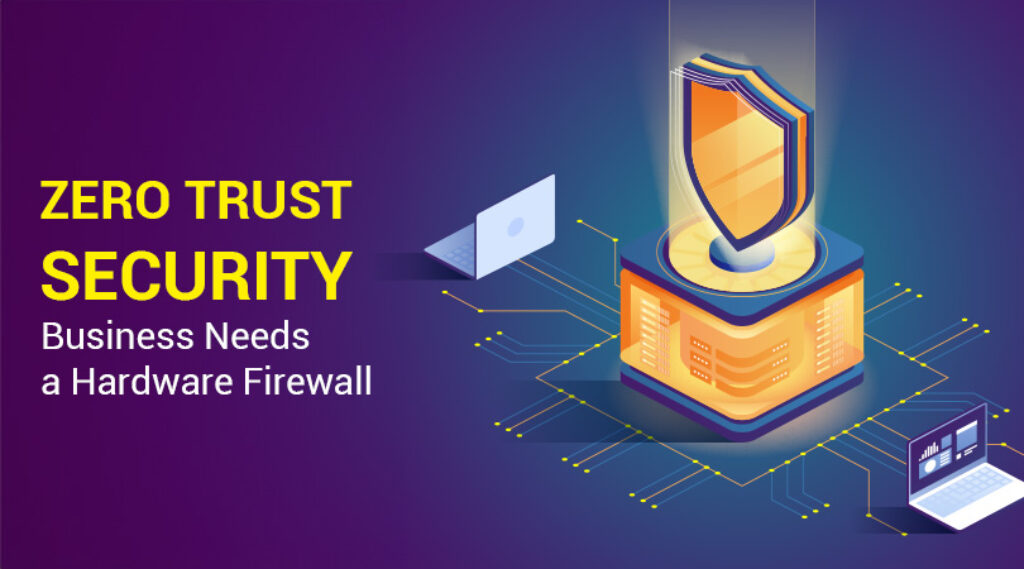
The hardware firewall is a specific physical device, designed specifically as an exclusive gatekeeper, placed strategically between the internal network of a business and the untrusted external world, primarily the vast cyberspace. Having one task to screen all incoming and outgoing network traffic, it functions as a safety guard, with regard to security issues, in a strict set of rules. Screening and managing this movement of digital information, the hardware firewall is like a giant electric fence. It secures from cyber-attacks that might attempt to extend towards your valuable data, critical systems, and ultimately the bottom line.
The First Line of Defense: Perimeter Security
Hardware firewalls are designed to repel anything that could be deemed as malicious for your business network. Any attempt made to communicate from the outside must pass through the firewall. Every packet of data that comes in is observed by the firewall, and its parameters are checked against security rules established by the IT administrators of the company. Parameters can range from source and destination IP addresses to port numbers and even the types of communication protocols employed in sending them.
The firewall prevents a suspected connection request that originates from a recognized malicious IP or tries to reach blocked ports or dubious protocols from ever pinging your servers, workstations, and other internal devices within the organization. Filtering such traffic at the outer periphery of the network is crucial in preventing long-range threats at the earliest, before they try to find and exploit vulnerabilities within.
Malicious Traffic and Intrusions Blocking
Detection and blocking of malicious traffic and other intrusion attempts is a significant achievement of hardware firewall capabilities, such as:
-
Malware:
Deep packet inspection-capable hardware firewalls will scan the contents of a data packet being sent, searching for indications of a virus, worm, Trojan, or other nefarious payload. If it identifies any trouble, it prevents its transmission into your network, so the firewall essentially guards your data integrity and operational stability.
-
Attempts for Unauthorized Access:
Intruders attempt unauthorized entry into internal networks by scanning open ports and taking advantage of known vulnerabilities. A hardware firewall, well configured, would serve as a wall to shut down unwanted ports and prevent any attempt at connection from suspicious or untrusted sources; thus, the firewall effectively makes your network invisible to most external threats.
-
DoS and Distributed Denial of Service Attacks:
These attacks, therefore, attempt to overwhelm your network resources with unauthorized traffic so the services are unavailable to authorized users. Although a hardware firewall alone can never be an exhaustive defense against the weighty DDoS attacks, most of the lighter DoS attacks can still effectively be kept at bay and sifted out at the perimeter by your hardware firewall, safeguarding your servers from being overwhelmed by suspicious traffic.
-
Data Exfiltration and Spyware:
Spyware can be installed on compromised systems to steal sensitive information by attackers. In such cases, a hardware firewall can be used to inspect outgoing traffic in order to block compromised internal systems from potentially communicating with identified command-and-control servers or transmitting stolen data to an external location.
Implementing Access Control Policies
In addition to filtering out bad traffic, a hardware firewall implements fine-grained access control policies within your network. During the installation of such devices, it is important to specify what internal resources can be accessed remotely and to what external resources the internal users can connect. For example, it allows internet access to the company website and email server but denies access to sensitive internal databases or admin interfaces solely on the basis of approved IPs or VPN connections.
Such control is essential to reduce the attack surface and unauthorized access to sensitive information. It restricts possible attacks and harm attempted from a compromised system or account by providing, on a hardware firewall, users and systems with access that is only required to carry out their tasks, i.e., the least privileges.
Network Segmentation and Containment
A hardware-based firewall with network segmentation features allows creating compartments of an internal network into diverse and isolated zones. It would be helpful to business organizations that have multiple departments or information that is considered sensitive enough to warrant strict control over access. For example, you can segregate the financial data network from the public web server network.
During the security breach incident on one segment, the hardware firewall serves as a hindrance, blocking lateral movement by the intruder across the entire network, hence compromising essential systems or obtaining sensitive data from other segments. The containment reduces the incident to a much smaller scope and magnitude.
Logging and Monitoring Threat Intelligence
One very important aspect of the protection provided by the hardware firewall is the ability to log and monitor network activity. It records connection attempts, blocked traffic, or any kind of security event. These logs serve as evidence of security events that help your IT team in analyzing suspicious patterns, conducting investigations against security breaches, and adjusting the security policies.
Consider doing regular monitoring of the firewall logs as a source of threat intelligence so that you know attacks that are being made against your network and therefore adjust your defenses accordingly. This proactive behavior is inseparably linked with staying ahead of the constantly evolving threat landscape.
Performance and Reliability
The hardware firewall has exclusive processing resources and power to achieve network safety functions and thus possesses high-throughput capability to service the large amount of network traffic streams without impacting the performance of your in-house systems. Software firewalls rely on the host machine for protection, while hardware firewalls possess solid and uniform protection without engaging in the struggle for processor use with other applications.
Conclusion: A Necessary Shield
With more and more sophisticated and relentless cyber attacks, no business can work without the defense of a hardware firewall. It acts as the first wall of defense by securing the network perimeter, blocking malicious traffic, and enforcing access control policies. It enables network segmentation and offers valuable logging and monitoring features. No matter how profound or advanced your cybersecurity strategy may be, a properly architected hardware firewall delivers robust security up front and reduces the risk.