Now Reading: Top 10 Cloud Computing Services
-
01
Top 10 Cloud Computing Services

Top 10 Cloud Computing Services
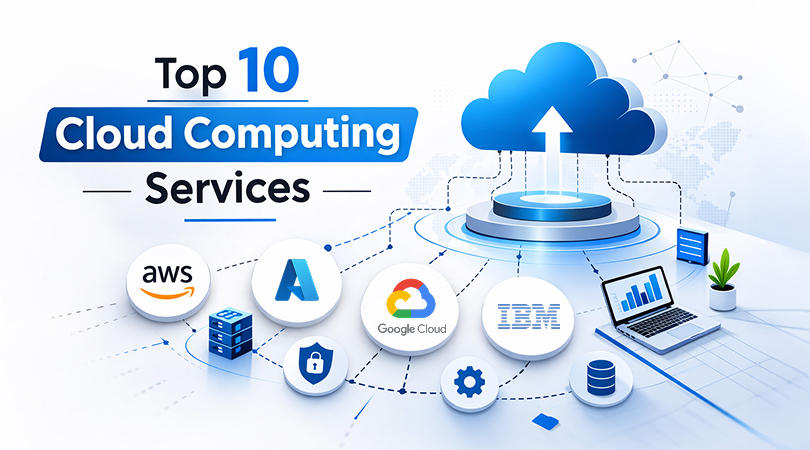
Cloud technology has helped transform the way contemporary businesses conduct business, innovate, and grow. In today’s digital-centric economy, companies depend on the top 10 cloud computing services to run applications, process data, and deliver smooth user experiences worldwide. Since a startup that takes advantage of the on-demand computing model to make a move on massive workloads to a mission-critical business that uses a secure cloud infrastructure, adopting cloud computing is no longer just an option but a strategic choice that can provide significant competitive advantages.
Cloud computing enables organizations to use virtual servers, remote data storage, distributed computing resources, and cloud-based applications without making large investments in physical hardware. Cloud service companies are defining the future of digital transformation through global data centers, high-availability hosting, and scalable cloud solutions.
Introduction to Cloud Computing Services
Cloud computing services can be described as the provision of computing facilities, such as servers, storage facilities, databases, networks, software, and analytics online. Businesses do not have to own and maintain physical infrastructure, but may use scalable and flexible cloud infrastructure on a pay-as-you-go basis. This model enables on-demand computing, allowing an organization to scale resources up or down immediately based on workload requirements. Cloud environments enable applications and services to be hosted across multiple data centers within a geographic region, ensuring improved performance, resilience, and global availability. The world-renowned cloud computing companies today have huge networks of data centers worldwide, which ensure reliability, high availability hosting, and secure remote storage. Today, most of the businesses are using cloud computing service to promote agility and innovation.
What Are Cloud Service Providers?
Cloud Service Providers is a company that provides computing services to the businesses for their seamless workflows. In simple words, you don’t need to put heavy servers or hardware in your office and data center, these providers will help you to adapt ready-to-use cloud infrastructure and platforms. Be it a startup, mid-sized business, or enterprise, everyone can use cloud services as per their needs.
Cloud service providers offer services to business like develop virtual machines, managed databases, remote data storage, and cloud-based applications. As well as you also get cloud security features, identity management systems, compliance support, data disaster recovery, and data backup solutions. One of the biggest benefits is that businesses don’t need to take the tension of managing hardware solutions; the entire process, such as scalability, uptime, and performance optimization, is handled by the provider, through which you can focus on your core business.
Why Businesses Are Moving to Cloud Computing
Companies are shifting to cloud computing because initial capital spending (CapEx) on hardware and data centers is no longer sustainable, and it is hard to ask companies to invest heavily in physical infrastructure. There is also a tendency to underestimate hardware requirements, especially during traffic spikes like major sales events, which can result in either overinvestment or system overload. Conventional on-premises systems often lack access to technologies such as AI, ML, and Big Data tools, which limits their innovation and competitiveness. Moreover, having highly skilled security teams and the ability to keep the systems updated at all times is costly and consumes resources. Physical hardware also, over time, reaches end-of-life, which requires organizations to perform expensive and risky large-scale replacements. Data can be corrupted forever or can make the system unusable due to local disasters like fire or power outages, which makes cloud-based solutions that have backup and recovery implemented in them much more dependable.
Types of Cloud Deployment Models
When choosing a cloud, it’s not enough to simply look at the provider understanding the deployment model is equally important. When you perform a proper cloud platform comparison, it becomes clear which model will best suit your business goals, security needs, and scalability requirements.
Public Cloud
In Public Cloud, computing resources are delivered through the public internet. Infrastructure owned and managed by the third-party cloud hosting providers. Multiple businesses are using the same underlying hardware, but their data and environment are completely isolated and secure.
This model is ideal for startups, web applications, SaaS, and those businesses that need on-demand computing and global availability. If you require fast deployment, low upfront cost, and scalable cloud solutions, then the public cloud is a strong option.
Private Cloud
A private cloud is a dedicated environment for a single organization. It could be hosted on-premises or managed through any third-party provider. The biggest advantage of this model is its enhanced security, customization, and full control. In industries like healthcare, banking, and finance, where strict compliance and data privacy are present, Private cloud infrastructure is preferred – especially for sensitive workloads.
Hybrid Cloud
A hybrid cloud is the combination of public and private clouds. In this cloud, we can easily move data and applications between the two environments. Businesses are using hybrid cloud so that they can maintain a perfect balance between security and scalability. For example, critical and sensitive data can be stored in a private cloud, while customer facing application can be run on a public cloud for high availability hosting. This flexibility can be beneficial for growing enterprises.
Multi-Cloud Strategy
A multi-cloud strategy means using services of multiple cloud service providers. In this approach business does not depend on a vendor, but it distributes workloads on different platforms. It reduces vendor lock-in risk, improves system resilience, and performance optimization becomes better. Multi-cloud also supports distributed computing environments and cross-platform redundancy, which is especially important for the large scale-enterprise.
Types of Cloud Service Provider Models
Cloud services are typically categorized into three primary models:
Infrastructure as a Service (IaaS)
Infrastructure as a Service is a very basic and flexible cloud model. In this model, cloud providers offer virtual servers, storage, networking, and core cloud infrastructure. Hardware and physical data center responsibilities are on the provider, but operating system, applications, and data management are handled by the business.
Platform as a Service (PaaS)
Platform as a Service (PaaS) is specially designed for developers. In this service, you don’t need to take tension of managing infrastructure. Provider offers you ready-to-use development frameworks, tools, a database, and a runtime environment. Developers can directly build, test, and deploy cloud-based applications. This model is perfect for those businesses that need faster deployment cycles and innovation without worrying about backend infrastructure management.
Software as a Service (SaaS)
Software as a Service (SaaS) is a simple and user-friendly model. In this, software applications are delivered on a subscription basis through the Internet. User doesn’t need installation or maintenance; you get access through the browser or app. Provider handles updates, security patches, and infrastructure management. This model is widely used for CRM systems, email services, collaboration tools, and other business applications.
Top 10 Cloud Computing Services
Below is a curated list of the best cloud computing services globally.
Amazon Web Services (AWS)
Amazon Web Services (AWS) is the largest cloud computing platform. It was introduced in 2006 and is the market leader in cloud infrastructure of the enterprise. AWS provides 200+ computing, storage, databases, analytics, machine learning, IoT, and security services with a wide network of global data centers to provide low-latency and high-availability hosting. It offers a pay-as-you-go pricing model, with Basic Instances, Reserved Instances, Savings Plans, and Spot Instances to optimize costs, and a Free Tier to new users, which makes it a perfect fit for scalable cloud solutions of any size.
Key Features Amazon Web Services (AWS)
- Elastic Compute Cloud (EC2) for virtual servers
- Simple Storage Service (S3) for remote data storage
- Advanced AI/ML services
- High availability hosting architecture
- Extensive compliance certifications
- Serverless computing with Lambda
Best Use Cases
AWS is suitable for every business, from startups to large enterprises and government organizations, especially for those who need scalable cloud solutions. This service is perfect for high-performance workloads, AI-based applications, large-scale distributed computing, and global SaaS. If you are expecting fast growth or want to expand on a global level, then AWS can be a strong option.
Microsoft Azure
A major example of a cloud platform is Microsoft Azure, which is one that has been integrated well with other Microsoft products, such as Windows Server and Microsoft 365. It provides hybrid cloud strengths, enterprise-ready cloud infrastructure, and advanced AI services to facilitate the digital transformation. Companies that have committed much of their resources to the Microsoft ecosystem are fond of Azure because of its convenient on-premises and cloud connectivity. Its pricing scheme is pay-as-you-use, and there is Reserved VM Instances of discounted long-term usage and Azure Hybrid Benefit to cut its expenses with the help of existing Microsoft licenses, and a free tier is offered to new users.
Key Features Microsoft Azure
- Strong hybrid cloud capabilities
- Integration with Microsoft ecosystem
- Advanced AI and analytics tools
- Global data centers
- Robust compliance framework
Best Use Cases
Azure is best suited for enterprises leveraging Microsoft technologies. It’s ideal for cloud finance, healthcare, and government organizations where strict security, compliance, and hybrid cloud infrastructure are needed.
Google Cloud Platform (GCP)
Google Cloud Platform (GCP) is usually popular due to its robust data analysis, Artificial Intelligence, and Kubernetes-based container orchestration capabilities. GCP is based on the global architecture of Google that drives other applications, such as Google Search and YouTube, and provides reliable and high-performance cloud services. It best fits well in organizations that require sophisticated data processing, AI services, or container-based frameworks to support efficient management of modern applications and massive workloads. GCP employs cost-efficient, scalable cloud computing with a pay-as-you-go pricing platform and sustained-use discounts and committed-use contracts, together with a free tier to provide new users.
Key Features of Google Cloud Platform (GCP)
- Compute Engine through scalable virtual machines
- Big Query for advanced data analytics
- Kubernetes Engine for container management
- AI and Machine Learning APIs
- High-speed global fiber network
Best Use Cases
GCP is ideal for AI-driven companies, data-intensive workloads, and containerized applications. If you’re focused on advanced analytics or using a Kubernetes-based architecture, GCP offers strong performance and scalability. It’s a powerful cloud platform option for modern tech startups and data-focused enterprises.
IBM Cloud
IBM Cloud is a good enterprise-oriented cloud system and is actually aimed at businesses that need a secure, reliable, and scalable cloud facility. The system is easily compatible with both hybrid and multi-cloud deployments to enable businesses to interconnect their data centers on-premises and the public cloud. The key emphasis areas of IBM Cloud include security, compliance, and performance that make it suitable for the regulated sectors like finance, healthcare, and government.
IBM Cloud has astronomical pricing. You have the option of a pay-as-you-go model, where you are only charged for what you use. There is also subscription-based pricing and reserved capacity pricing, which is economical in the case of long-term workloads. Enterprise agreements are also customized to large enterprises, and therefore, it is easy to budget and optimize costs.
Key Features IBM Cloud
- Strong hybrid cloud support with Red Hat OpenShift
- AI integration through IBM Watson
- High-level security and compliance standards
- Industry-specific cloud solutions
Best Use Cases
IBM is the best option for that demand advanced data protection, regulatory adherence, and seamless integration across on-premises and cloud environments.
Oracle Cloud Infrastructure (OCI)
Oracle Cloud Infrastructure (OCI) is a high-performance computing and database-intensive workload cloud infrastructure platform powered by a highly scalable architecture. The key strength of OCI is that it has been optimized a lot to work with Oracle databases, and this has enhanced the performance, reliability, and scalability of oracle database. It offers high-level networking and storage solutions to effectively operate modern applications, enterprise workloads, and mission-critical workloads.
On the price model, OCI is based on a competitive and transparent cost model. There is clear pricing of pay-as-you-go, and this will limit the problem of secret charges. There are also features of reserved capacity and long-term use deductions that enable businesses to have a stable budgetary forecast and cost management.
Key Features
- Oracle databases for optimized infrastructure
- High enterprise-grade performance
- Secure and high-speed cloud networking
- Transparent and predictable pricing model
Best Use Cases
OCI is ideal for those enterprises that want to run Oracle workloads, database-heavy applications, and large-scale enterprise systems with the high-performance and security.
Alibaba Cloud
Alibaba Cloud has been deemed to be the largest in Asia and is growing at a high rate in the world. It offers a scalable cloud solution to startups and large-scale businesses. Alibaba Cloud uses a solid global network of data centers, which form the infrastructure through which businesses can have high availability hosting and stable performance.
The platform contains a large variety of computing, storage, networking, big data, AI, and security services. This pricing is a competitive model, paying as you go model, which enables the companies to control the costs depending on their use. There are subscription-based and long-term plans that are offered under long-term workloads as well, which allows optimizing the cost.
Key Features of Alibaba Cloud
- The Asia-Pacific region in strong market presence
- Advanced big data and analytics capabilities
- Secure and compliant cloud infrastructure
- Elastic compute services for scalable workloads
Best Use Cases
Alibaba is the best option for those businesses that are targeting Asian markets or want to expand their digital presence in China and the Asia-Pacific region.
Salesforce
Salesforce is a technology company that provides SaaS-based enterprise cloud services and is mostly referred to as a Customer Relationship Management (CRM) solution. It assists enterprises in sales, marketing, customer service, and business operations with respect to cloud-based applications. Contrary to the conventional programs, there is no software to install since Salesforce is fully cloud-based and accessible from a distance, allowing real-time data visibility.
It boasts a subscription pricing strategy and offers different types of plans- personalized plans can be offered to any small business or to any large company. The number of people in a team and the features needed allow companies to select a plan, keeping the cost and scalability under control.
Key Features of Salesforce
- Industry-leading CRM platform
- Advanced cloud analytics and reporting tools
- App development platform (Salesforce App Cloud)
- Strong third-party integration ecosystem
Best Use Cases
Salesforce can be the best for those businesses that want to streamline and automate customer relationship management, sales automation, marketing campaigns, and customer support.
VMware
VMware has been a leader in virtualization technology and boasts a good name in hybrid cloud solutions. It assists companies with uniting their conventional data centers on-premises with the contemporary cloud spaces. Solutions offered by VMware enable businesses to leverage their current hardware base as well as easily migrate the workload to the private, public, or hybrid clouds.
VMware is concerned with flexibility, security, and efficiency of operations. Its ecosystem supports the use of various public clouds, which means that enterprises can use the multi-cloud strategy and avoid significant infrastructure transformation. Subscriptions are mostly used as the basis of pricing, and the restricted models of licensing change depending on workload and the type of deployment.
Key Features VMware
- Virtualization technology in industry leadership
- Seamless hybrid cloud integration
- Strong enterprise-grade security framework
- Advanced multi-cloud management tools
Best Use Cases
VMware is the perfect choice for those enterprises that are transitioning from their on-premises infrastructure to a hybrid cloud model and want smooth workload migration.
Tencent Cloud
Tencent Cloud is a fast-rising cloud service provider that offers on-demand cloud computing and performance computing services. It has a good reputation, particularly in the gaming, media streaming, social, and AI-assisted services. Tencent has a history of serving mass-scale digital systems; therefore, its infrastructure is highly efficient in supporting high volume and real-time applications.
The platform has a broad range of computing, storage, networking, big data, artificial intelligence, and security services. Its pricing model is adaptable, and there are also pay-as-you-go and customized enterprise plans. This enables businesses to maximize costs according to their requirements of use and performance.
Key Features of Tencent Cloud
- High-performance gaming infrastructure
- Advanced AI and big data capabilities
- Strong global expansion strategy
- Secure and reliable cloud networking
Best Use Cases
Tencent Cloud is best for media companies, online gaming platforms, streaming services and digital businesses that demand high traffic and real-time performance.
Cloud Computing Market Trends in 2026
In the 2026 cloud computing industry has become more advanced and strategic. Businesses are not only using the cloud, but they are also adopting smarter and future-ready approaches. Here we give short overviews of major trends:
- Multi-Cloud and Hybrid Cloud Adoption: Companies are using multiple cloud providers for flexibility. It reduces vendor lock-in and makes performance better.
- AI-Powered Cloud Services: AI tools such as predictive analytics and automation are become core part of cloud.
- Edge Computing Growth: Processing data closer to the user reduces latency and improves the performance of real-time applications.
- Cloud Security & Compliance Focus: Increased emphasis is being placed on zero-trust security, encryption, and compliance tools.
- Serverless & Containers: Developers are now focusing on direct application development rather than managing infrastructure.
AWS vs Azure vs Google Cloud
| Feature | Amazon Web Services | Microsoft Azure | Google Cloud Platform |
| Market Position | Largest global market share, most mature cloud infrastructure | Strong second position, dominant in enterprise IT | Rapidly growing, strong in AI and analytics |
| Compute Services | EC2 virtual servers, Lambda (serverless), ECS, EKS | Virtual Machines, Azure Functions, AKS | Compute Engine, Cloud Functions, GKE |
| Storage Options | S3 object storage, EBS, Glacier archival | Blob Storage, Disk Storage, Archive Storage | Cloud Storage, Persistent Disk, Archive |
| Pricing Model | Pay-as-you-go, Reserved Instances, Savings Plans | Pay-as-you-go, Reserved VM Instances, Hybrid Benefit | Pay-per-second billing, Sustained-use discounts |
| Hybrid Cloud Capabilities | Strong with Outposts | Industry-leading hybrid via Azure Arc | Anthos for hybrid and multi-cloud |
| AI & Machine Learning | SageMaker, AI APIs, Bedrock | Azure AI, Cognitive Services | Vertex AI, strong ML innovation |
Benefits of Using Cloud Computing Services for Business
Today Cloud Computing give strong support to your business fast growth and secure operations. Let’s see its main benefits:
- Scalability and Flexibility: Resources such as virtual servers and storage can instantly scale up or down, according to the demand.
- Cost Efficiency: Pay-per-use model you only need to pay for what you use, it will reduce infrastructure cost.
- High Availability and Disaster Recovery: Data store on multiple locations, through which your downtime will reduce, and business continuity remains maintain.
- Enhanced Data Security: Advanced encryption and compliance standards help you to secure your sensitive data.
How to Choose the Right Cloud Computing Service
- Budget and Pricing Model: Evaluate pay-as-you-go vs reserved pricing options.
- Scalability Requirements: Choose scalable cloud solutions that align with growth projections.
- Compliance and Security Needs: Ensure the provider meets regulatory standards.
- Technical Support and SLAs: Assess uptime guarantees and support responsiveness.
- Integration with Existing Systems: Consider compatibility with legacy systems and cloud-based applications.
Conclusion
These Top 10 Cloud Computing Services are a good choice when you have a clear vision of what you want to achieve with your business, the extent to which you will grow, and the level of compliance that is required. Major cloud service vendors provide robust cloud service infrastructure, distributed computing, and high-availability hosting that can help with digital transformation. It has been observed that no matter whether comparing AWS vs Azure vs Google Cloud or trying to test enterprise cloud solutions, cloud platform comparison is key to long-term success.
The cloud computing businesses are never standing still- AI-powered service, edge computing, and sustainable data centers around the world. With the right choice of cloud computing service provider, companies can achieve cost efficiency, high agility, and a significant competitive advantage even in 2026 and beyond.
Get free expert cloud consultation today call +91 979797-0004 or email sales@wroffy.com and discover the best cloud computing services tailored to your business needs.